
Inga 3 is a decade from power, so mines are fixing the old dams
The World Bank, Washington and Kinshasa all moved Inga 3 forward in 2026, but its design, buyers and governing law are still undecided, and the copper mines it is meant to serve are planning without it.
https://inyanga.co/research/inga-hydropower/
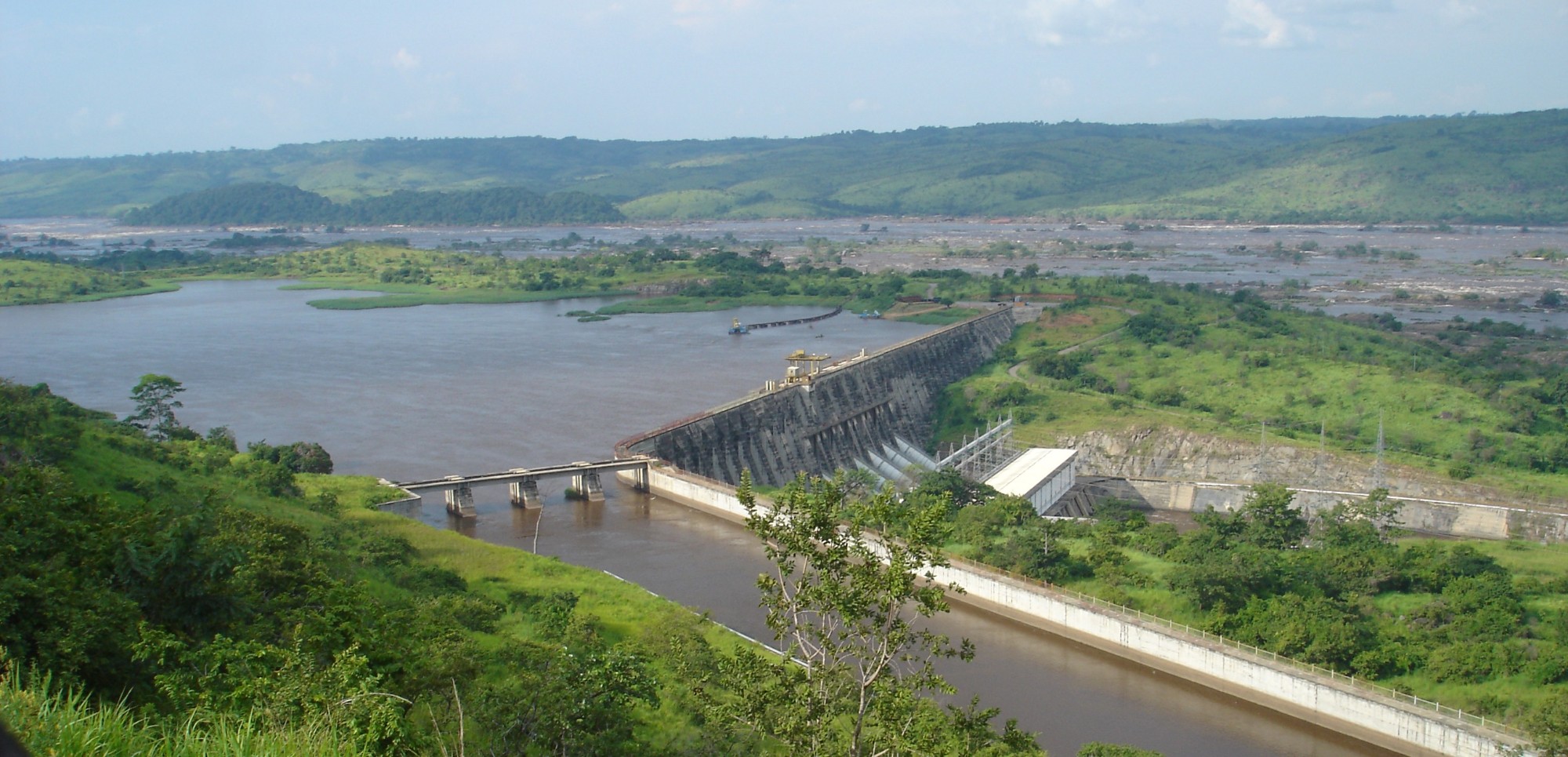
Inga 1 dam and the canal that feeds Inga 2, February 2009. Photograph: Radio Okapi, via Wikimedia Commons, CC BY 2.0. Source · License

Contents
- Summary
- 1The two existing dams produce well below what they were built for
- 2Mining companies now pay to rebuild Inga’s turbines and the grid that carries their power
- 3Inga 3 is still at the stage of choosing what to build
- 4Three moves in 2026 added structure, but not buyers or money
- 5What this means for US investors, lenders and operators
- 6What to watch
- 7Glossary
- Notes and sources
Summary
Inga 3, the next dam planned at the Inga falls on the Congo River, has not reached any of the milestones that come before construction. It has no chosen design, committed buyers for its power, developer, enacted legal framework or financing. Activity around it grew in 2026, with a World Bank preparation program that took effect in February, a draft Inga law adopted by the cabinet in March and a US-Congolese committee that first met in October. Even on the World Bank’s own sequence, a design choice comes first and construction takes at least five years after financing. We assess it is very unlikely that Inga 3 delivers power before 2033. The Inga power that reaches the copper and cobalt mines of the south this decade will come from the two existing dams, Inga 1 and Inga 2, whose turbines and transmission the mining companies are paying to restore.
- Inga 1 and Inga 2 have a combined installed capacity of 1,775 MW, 65% of the Democratic Republic of the Congo’s (DRC) generating capacity, and both are under rehabilitation. A World Bank evaluation found they were available only 49% of the time in the first three quarters of 2017.12
- The World Bank approved a $250 million first phase of a planned $1 billion Inga 3 program on 3 June 2025; it took effect on 2 February 2026. By April 2026, $12 million had been disbursed, and the government had not yet chosen which version of Inga 3 to build, a choice the program expects by June 2030.13
- The cabinet adopted a draft law on Grand Inga on 27 March 2026. President Félix Tshisekedi called it a precondition for the World Bank’s support, but we found no record that parliament has passed it.45
- South Africa’s 2019 electricity plan counted on 2,500 MW from Inga by 2030. Its 2025 plan, published on 28 October 2025, does not mention Inga, although the two governments say they are discussing exports of up to 5,000 MW.678
- Ivanhoe Mines paid to rebuild a 178 MW turbine at Inga 2, yet its Kamoa-Kakula copper complex plans to meet most of its growth with on-site solar and to keep 214 MW of diesel generators as backup. It expects its grid supply to reach 210 MW by the end of 2027 and to grow no further.910
We hold this judgment with high confidence, because it rests on the World Bank’s own milestones and on the absence of any signed purchase agreement or financing. Our account of what mines pay for rests on company reports, because their contracts with the state power company are not public.
1The two existing dams produce well below what they were built for
Inga 1 and Inga 2 were completed in 1972 and 1982 on the lower Congo River in Kongo Central province. Their combined installed capacity of 1,775 MW is 65% of the country’s total, according to the World Bank, and both plants are being rehabilitated.1 Inga 2 alone has eight turbines and can generate up to 1.4 gigawatts (GW), according to Ivanhoe Mines.9 The DRC as a whole has about 2,700 MW of installed capacity, mostly owned by the state utility, the Société nationale d’électricité (SNEL), and 95% of it hydropower.1
The plants have long run well below that capacity. A World Bank power project approved in 2007 and closed in 2018 rehabilitated 632 MW of capacity at Inga, against a target of 860 MW, and left 1,432 MW of capacity available. It raised the energy generated at Inga from 3,715 to 9,801 gigawatt hours.2 Yet the World Bank’s evaluators found that the two plants were available only 49% of the time in the first three quarters of 2017, against a target of 75%.2 We found no more recent public figure for their output. SNEL’s finances explain much of the gap: about 46% of the electricity it produces is not delivered, billed and collected, it carries more than $2 billion of debt, and the government is behind on its bills.111
According to Bloomberg, most of Inga’s electricity travels about 1,000 miles (1,600 kilometers) across the country to the copper and cobalt mines of Lualaba and Haut-Katanga.12 The World Bank’s December 2024 concept note put the country’s power deficit at 2,750 MW and noted that mines combine grid power, imports and their own generators, including diesel.13 According to press reports in October 2026, the Chambre des Mines, which represents the large mining companies, says its members have spent $1.5 billion to secure their electricity supply. It also says the state has not fully honored its side of the agreements.14
2Mining companies now pay to rebuild Inga’s turbines and the grid that carries their power
The clearest case is Ivanhoe Mines, which operates the Kamoa-Kakula copper complex near Kolwezi in Lualaba. Ivanhoe financed the refurbishment of Turbine 5 at Inga 2, a 178 MW unit, through loans to SNEL. Work began in 2022, the new equipment was installed in the third quarter of 2025, and the turbine was producing about 180 MW for the national grid by November 2025.915
Only part of that power reaches the mine, because the grid between Inga and Kolwezi cannot yet carry it. Kamoa-Kakula received an initial 50 MW in November 2025. Ivanhoe expected 100 MW in the first quarter of 2026, once a static compensator at the Kolwezi substation was finished, and 150 MW in the first half of 2027, after filter banks at the Inga and Kolwezi substations are upgraded.9 Ivanhoe’s results for the second quarter of 2026 do not report how much Inga power the mine received, and its September 2026 presentation repeats the plan rather than reporting progress.1610 The company describes its program with SNEL as a $450 million investment in “long-term DRC grid improvement projects”.10
Planned power supply and demand at Kamoa-Kakula, megawatts, December 2025 to December 2028
Data
| Month | Grid (SNEL) | Imports | On-site solar | Total supply | Demand | Diesel backup |
|---|---|---|---|---|---|---|
| December 2025 | 110 | 100 | 0 | 210 | 208 | 178 |
| December 2026 | 180 | 100 | 60 | 340 | 271 | 214 |
| December 2027 | 210 | 100 | 60 | 370 | 292 | 214 |
| December 2028 | 210 | 40 | 120 | 370 | 347 | 214 |
Source: Ivanhoe Mines, investor presentation, 21 September 2026, slide 14; Ivanhoe Mines, news release, 25 November 2025, table 1.
Notes: December 2025 is reported; later months are company plans. Imports come from Zambia and Mozambique. In its November 2025 release Ivanhoe planned 100 MW of imports and 60 MW of solar for December 2028.
The plan shows how a mine that has paid for Inga capacity judges the grid. Kamoa-Kakula’s demand is expected to rise from 208 MW at the end of 2025 to 347 MW at the end of 2028. Grid supply, including Inga, is planned to stop growing at 210 MW from 2027, and the rest comes from imports and solar.10 The first solar plants with battery storage, 60 MW owned by CrossBoundary Energy and Green World Energie, began supplying the mine in July 2026. Ivanhoe has signed for a further 30 MW and is negotiating another 30 MW to reach 120 MW.16 From December 2026 the mine plans to keep 214 MW of diesel generators, more than its planned grid supply.10
3Inga 3 is still at the stage of choosing what to build
“Inga 3” names the next project at the site, not a fixed design. Studies by EDF and AECOM in 2013, updated in 2018, prepared a 4,800 MW “low head” option, and the government has since examined designs of up to 11,000 MW.1 The World Bank expects Inga 3 to cost more than $10 billion, to take several years to prepare and at least five years to build, and to be financed as a public-private partnership outside its preparation program.1 Its December 2024 concept note put the financing needed at $15 billion to $25 billion, a third to a half of the DRC’s gross domestic product.13
The project has changed hands several times. The World Bank cancelled an earlier Inga 3 technical assistance project in 2016, after the government changed its implementation arrangements unilaterally and only 4% of the money had been spent.1 A Spanish and Chinese consortium then failed to develop an 11 GW version, Fortescue of Australia was brought in to replace it, and in May 2024 the presidency said Fortescue would no longer develop the site. It signed a preliminary agreement with Natural Oilfield Services, a Nigerian oil company, for feasibility studies on a 7 GW plant; Fortescue said it had not been notified of any change to its agreement.12
The World Bank’s program sets the order of what must happen next. Its first phase ends when the government chooses a version of Inga 3. The separate construction project can start only when there is agreement on design, “clarity on key off-takers”, interest from credible public and private investors and a legal and regulatory framework.1 Progress on the first step has been slow. The program became effective eight months after approval, and its implementation rating fell from satisfactory to moderately satisfactory in April 2026. The indicator for identifying technical and financial options for Inga 3 was still at “No”, with a target of March 2027.173 The agency in charge, the Agence pour le Développement et la Promotion du Projet Grand Inga (ADPI), has hired AECOM to update the study of technical options, bankable demand and geology.18
Conditions set in the World Bank’s Inga 3 program and their status, as of 2 November 2026
| Condition | Status |
|---|---|
| Choice of design and size | Not made. Options run from 4,800 MW to 11,000 MW; AECOM is updating the options study. |
| Committed buyers for the power | None signed. South Africa’s political agreement for 2,500 MW is not a purchase contract, and its 2025 plan omits Inga. |
| Developer | None selected under the current process; the 2024 preliminary agreement with Natural Oilfield Services covered feasibility studies only. |
| Legal framework | Draft Inga law adopted by the cabinet on 27 March 2026; no record of a parliamentary vote. |
| Financing | $250 million of preparation money approved, $12 million disbursed by April 2026. Construction finance not arranged. |
| Transmission to buyers | The cost estimate used by the World Bank includes a new line to the Katanga region; we found no funding for one. |
Source: World Bank, Project Appraisal Document PADHI01064 (2025), 13, 15, 19, 31; World Bank, Implementation Status and Results Report, sequence 2 (April 2026); Actualite.cd, 29 March 2026; Bloomberg, 22 May 2024; South Africa, Integrated Resource Plans 2019 and 2025.
4Three moves in 2026 added structure, but not buyers or money
The first move was legal. On 27 March 2026 the cabinet adopted a draft law on the implementation of the Grand Inga project, presented by Aimé Molendo Sakombi, minister of water resources and electricity. Tshisekedi had told the government to send it to parliament by 31 March and called it a precondition for mobilizing the World Bank’s support.4 The World Bank had made the cabinet’s adoption of an Inga law, and its transmission to parliament, a trigger for its next budget-support operation.11 The bill was on the agenda of an extraordinary session of the National Assembly called on 26 June 2026.5 We found no record that either chamber has passed it. An opinion piece in Le Majestic in August 2026 described reservations among members of parliament, some of whom see no need for a separate law, and among civil society groups, over tax exemptions and the powers the bill gives ADPI.19
The second move was diplomatic. The Strategic Partnership Agreement that the United States and the DRC signed on 4 December 2025 includes an article on the Grand Inga dam. The two governments “intend to establish a Grand Inga Hydropower Project Coordination and Governance Committee”, with equal representation, to mobilize capital, including from development finance and export credit institutions, and to “promote opportunities for U.S. persons and aligned persons”.20 The committee held its first meeting in Paris on 26 October 2026 at the World Bank’s offices. It was co-chaired by Daniel Mukoko Samba, deputy prime minister and minister of the national economy, and Jeremy Wiggins, a US Treasury official responsible for development finance policy. They discussed structuring, financing, risk-sharing and transmission, and the published account of the meeting mentions no financing commitment.21
The third move concerned the buyer named most often. Under its treaty with the DRC on Grand Inga, South Africa had a ten-year window, ending in 2023, in which it was obliged to take 2,500 MW, and its 2019 electricity plan included that amount by 2030. The same plan warned that the treaty might lapse and adopted 2,500 MW of nuclear power as a fallback “in case the Inga project does not materialize”.6 In March 2026 the DRC’s ministry said talks would resume in April to raise exports to 5,000 MW.8 But South Africa’s Integrated Resource Plan 2025 does not mention Inga, and its section on hydropower names only the existing 1 GW import from Mozambique’s Cahora Bassa and a possible pumped storage scheme in Lesotho.7
We assess it is very unlikely that Inga 3 delivers power to any customer before 2033. Before construction can start, the government must choose a design, and the World Bank’s program does not expect even the options for that choice to be identified before March 2027. It must also sign buyers, pass a law and assemble more than $10 billion of financing, and construction then takes at least five years.13 We hold this judgment with high confidence, because it rests on the World Bank’s own milestones and on the absence of any signed purchase agreement or financing. The alternative is a smaller first stage built quickly by a single sponsor outside the World Bank process, which the 2024 agreement with Natural Oilfield Services proposed. It would need its own buyers and financing, and we have seen no evidence of progress on it.12
5What this means for US investors, lenders and operators
Our earlier report on who controls the DRC’s copper and cobalt found that the smelter at Kamoa-Kakula makes sense partly because its owners paid to refurbish state hydropower plants, and that few projects meet that condition.15 This brief is consistent with that judgment and extends it. For a mine in the south, Inga means the two old dams and the grid to Kolwezi, and access to their power depends on a contract with SNEL that the mine helps finance.
For an investor or lender assessing a Congolese mine, the base case for power until at least the early 2030s is the existing grid, imports from Zambia and Mozambique, on-site solar and diesel. Inga 3 belongs in the upside case. A loan or offtake contract that assumes Inga 3 power within its term should be tested against that view. A mine’s power agreement with SNEL deserves the same diligence as its mining license. The terms to check are whether it guarantees priority access to the capacity the mine financed and how the advances are repaid, which are the terms the Chambre des Mines says the state has not fully honored.14
For US engineering, equipment and finance firms, the opportunities in the next few years lie in rehabilitation and transmission: turbines at Inga 1 and Inga 2, substations and lines between Inga and Kolwezi, and solar and storage at mine sites. The Inga 3 work under way now consists of studies and advisory contracts financed by the World Bank and procured by ADPI.18 The US-DRC committee may open doors for US firms, but its text promises coordination and capital mobilization, not contracts.20
6What to watch
- The government’s choice of an Inga 3 design and size, informed by AECOM’s updated options study. In our judgment, a choice in 2027 would leave construction possible from about 2030 and first power in the mid-2030s, and no choice by the end of 2027 would push first power later.
- A parliamentary vote on the Grand Inga law, and whether the version passed keeps the tax exemptions and ADPI’s powers that drew objections.
- Any signed power purchase agreement for Inga 3, with SNEL, a mining company, South Africa or another country. A political memorandum is not a purchase agreement.
- Whether South Africa’s next update to its resource plan brings Inga back in.
- Kamoa-Kakula’s reported grid supply in Ivanhoe’s quarterly results, as a measure of whether the Inga to Kolwezi grid upgrades deliver the planned 150 MW from Turbine 5 by mid-2027.
- The outcome of the Chambre des Mines’ dispute with the government over priority access to mine-financed capacity and repayment of advances to SNEL.
- Disbursement in the World Bank’s next progress report on the Inga 3 program, and any second-phase approval.
7Glossary
- ADPI
- Agence pour le Développement et la Promotion du Projet Grand Inga, the Congolese agency in charge of developing the Inga site.
- DRC
- Democratic Republic of the Congo.
- Grand Inga
- The full development of the Inga site, which the World Bank puts at about 42,000 MW across up to eight projects.
- GW, MW
- Gigawatt and megawatt. One gigawatt is 1,000 megawatts.
- Inga 1, Inga 2
- The two hydropower plants built at Inga in 1972 and 1982, with 1,775 MW of installed capacity between them.
- Inga 3
- The next project planned at the site; its design and size have not been chosen.
- IRP
- Integrated Resource Plan, South Africa’s long-term plan for electricity supply.
- SNEL
- Société nationale d’électricité, the DRC’s state power utility.
Notes and sources
Sources were accessed on 2 November 2026. Quotations from French texts are our translations unless the original is given in the note.
- World Bank, Project Appraisal Document on a Proposed Credit in the Amount of US$150 Million and a Shorter Maturity Loan in the Amount of US$100 Million to the Democratic Republic of Congo for an Inga 3 Development Program, Report No. PADHI01064, 7 May 2025, 9 (installed capacity of about 2,700 MW, 95% hydropower; SNEL debt above $2 billion and 46% of energy not delivered, billed and collected), 11 (Inga 1 and 2, 1,775 MW, 65% of capacity, under rehabilitation; Grand Inga potential of about 42,000 MW; 4,800 MW low head option and designs up to 11,000 MW), 13 (memorandum with South Africa for 2,500 MW), 15 (cost over $10 billion, at least five years to build, separate PPP project), 19 (Table 3, milestones), 26 (cancellation of project P131027 in 2016 with 4% disbursed), 31 (illustrative 4,800 MW case including a new line to the Katanga region). Back
- World Bank Independent Evaluation Group, Implementation Completion Report Review: Regional and Domestic Power Markets Development Project (P097201), 2 April 2020, 3, 7 and 8 (availability of Inga 1 and 2 at 49% in the first three quarters of 2017 against a target of 75%; 632 MW rehabilitated; 1,432 MW available; energy generated rising from 3,715 GWh to 9,801 GWh). Back
- World Bank, Implementation Status and Results Report: Inga 3 Development Program (P506438), sequence 2, archived 24 April 2026, 1 to 4 and 8 (effective 2 February 2026; implementation progress rated moderately satisfactory; “Government’s Inga 3 design choice informed and validated” at “No” on 17 April 2026, target June 2030; “Technical and financial options for Inga 3 identified” at “No”, target March 2027; $12 million disbursed of credit IDA-78160 and none of IDA-78150). Back
- Clément Muamba, “RDC: le gouvernement adopte le projet de loi sur la mise en œuvre du projet Grand Inga,” Actualite.cd, 29 March 2026, reporting the minutes of the Council of Ministers of 27 March 2026 read by government spokesman Patrick Muyaya (the text is « un préalable déterminant à la mobilisation du soutien financier convenu avec la Banque mondiale »). Back
- “Assemblée nationale: une session extraordinaire convoquée ce vendredi pour l’examen de 25 matières prioritaires,” 7sur7.cd, 26 June 2026, item 18 (« Projet de loi relatif au développement du site hydroélectrique de Grand Inga »). Back
- South Africa, Department of Mineral Resources and Energy, Integrated Resource Plan (IRP2019), Government Gazette No. 42778, 18 October 2019, 43 to 44 (policy position 8 and section 5.3.7: the treaty’s ten-year window ending in 2023, 2,500 MW from Grand Inga selected by 2030, and nuclear as a fallback). Back
- South Africa, Department of Electricity and Energy, Integrated Resource Plan, October 2025, Government Gazette No. 53596, 28 October 2025, section 3.2.3.1 (hydro imports limited to the 1 GW allocation from Cahora Bassa). We searched the full text, read by optical character recognition, and found no reference to Inga or the DRC. Back
- “DR Congo, South Africa to resume Inga 3 talks, eye up to 5,000 MW exports,” Ecofin Agency, 20 March 2026, citing a statement of the DRC Ministry of Hydraulic Resources and Electricity of 12 March 2026. Back
- Ivanhoe Mines, “Ivanhoe Mines Announces Completion of Hydropower Ramp-Up of 178-Megawatt Turbine #5 at Inga II,” news release, 25 November 2025, 2 to 3 and table 1. Back
- Ivanhoe Mines, investor presentation, 21 September 2026, slides 13 and 14 (“Increasing diversification of power sources”: supply and demand table for December 2025 to December 2028; “$450M investment in long-term DRC grid improvement projects in conjunction with SNEL”; imports from Zambia and Mozambique). Back
- World Bank, Program Document for a Proposed Development Policy Financing: First DRC Governance, Transparency and Economic Resilience Development Policy Financing (P507861), 2025, indicative trigger 6a (cabinet adoption of the draft Inga law and its transmission to parliament) and paragraph 60 (46% of SNEL’s electricity not delivered, billed and collected; government arrears). Back
- Bloomberg News, “Fortescue Excluded from World’s Biggest Hydropower Plant Development,” Bloomberg News, 22 May 2024, as republished by Mining.com. Back
- World Bank, Project Information Document, Concept Stage: Inga 3 Development Program (P506438), Report No. PIDDC00824, 9 December 2024, 3 (power deficit of 2,750 MW; mines rely on domestic power, imports and self-generation) and 5 (financing of $15 billion to $25 billion, a third to a half of GDP). Back
- Moussa Kéita, “RDC: la Chambre des mines réclame des contreparties énergétiques,” Africtelegraph, 3 October 2026, citing Financial Afrik. We have not seen a statement from the Chambre des Mines itself. Back
- Inyanga Research, “Who controls the Copperbelt’s copper and cobalt,” 22 October 2026, section on refining. Back
- Ivanhoe Mines, “Ivanhoe Mines Issues 2026 Second-Quarter Financial Results, Overview of Operations and Exploration Activities,” news release, 29 July 2026 (on-site solar facilities owned by CrossBoundary Energy and Green World Energie; first 15 MW delivered in July; plans for 120 MW). Back
- World Bank, Implementation Status and Results Report: Inga 3 Development Program (P506438), sequence 1, 7 September 2025, 1 (approved 3 June 2025, effectiveness expected by the end of November 2025). Back
- World Bank, Inga 3 Development Program (P506438): Procurement Plan, 13 October 2026, contract ZR-ADEPI-537989-CS-CDS with AECOM Consultants Inc. (« actualisation de l’étude des options techniques, de la demande bancable et des reconnaissances géologiques pour le développement du projet INGA-3 »). Back
- Tite Liongi, “Projet de loi Inga: entre ambition énergétique et crainte d’une « zone d’exception », le scepticisme du législateur congolais,” Le Majestic, 14 August 2026 (opinion). Back
- Strategic Partnership Agreement between the Government of the United States of America and the Government of the Democratic Republic of the Congo, signed at Washington, 4 December 2025, preamble and article X. US Department of State. Back
- “Grand Inga: la RDC et les États-Unis lancent un mécanisme conjoint pour accélérer le projet,” Actualite.cd, 26 October 2026. Back